

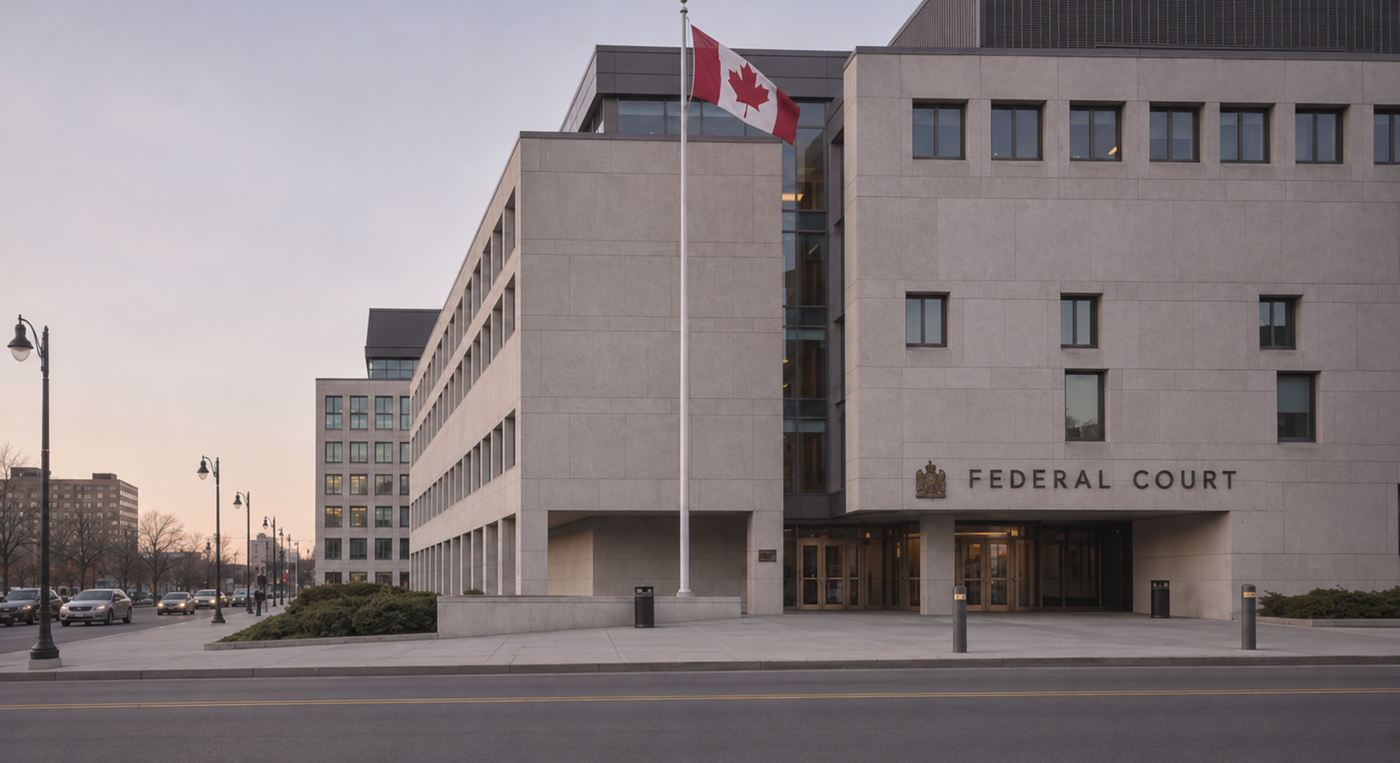
If your Canadian immigration, visa or citizenship application has gone quiet for months, or even years, you may be wondering what recourses are available to you.
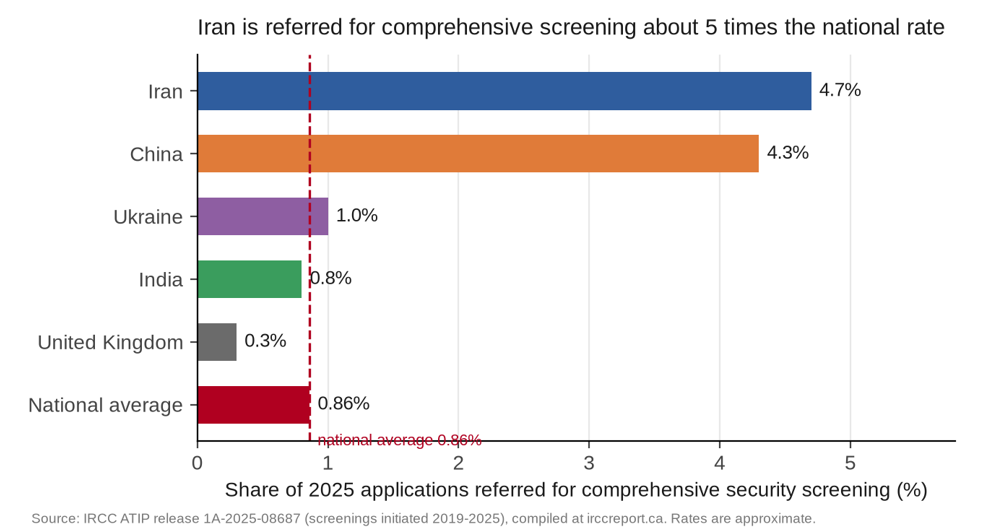
For Iranian applicants, security screening is the most common reason a file stalls well past the processing time published on the IRCC website. In 2025, roughly 4.7% of Iranian applications were sent to CBSA and CSIS for comprehensive security screening. The national average was 0.86%, which means Iranian files were referred roughly five times as often as the average applicant. Thousands of Iranian files are referred every year.
The good news is that the law has an answer. It is called mandamus. It is a Federal Court order that compels the government to finally make a decision. Iranian applicants have won these cases repeatedly since 2024, with courts ordering IRCC to decide within 30 to 60 days and awarding costs against the government.
1. Why Iranian Files Stall
Canada has a documented history of screening Iranian applicants at disproportionate rates. Public records released under the Access to Information Act show that Iranian files are referred for comprehensive screening far more often than applicants from almost any other country, and referrals climbed again from 2022 onward.
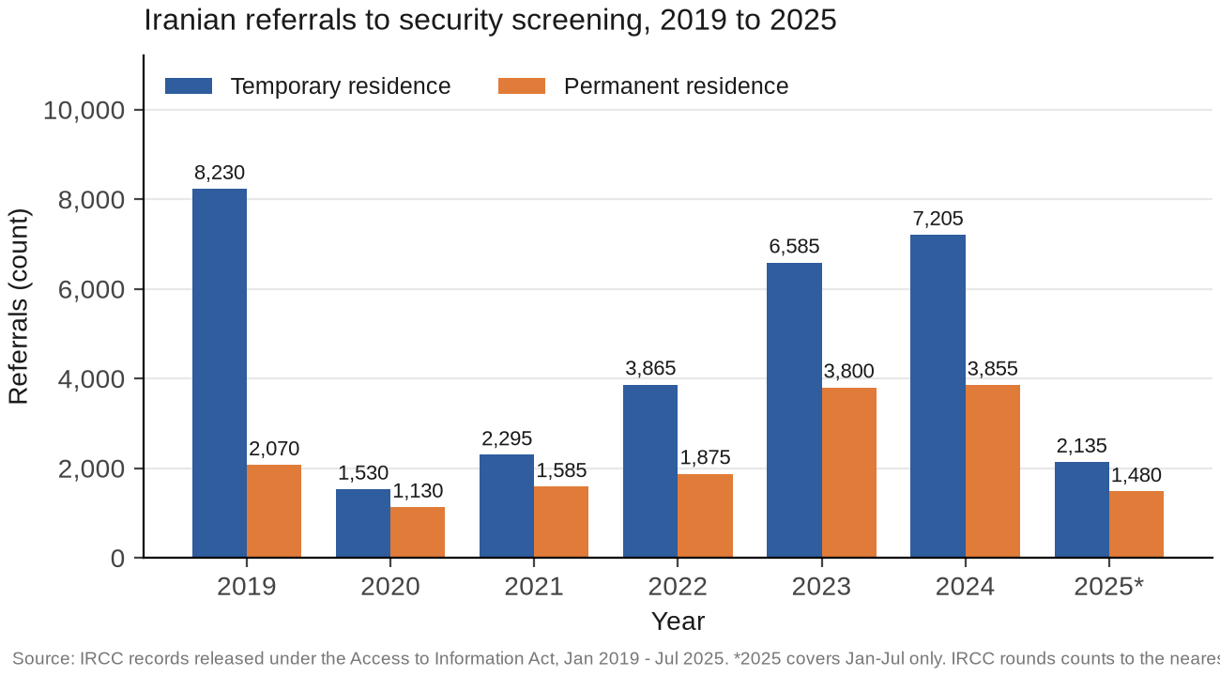
Between January 2019 and July 2025, Iranian applicants were referred for screening roughly 47,600 times, and the same records show only about 130 non favourable screening results. That works out to be under 0.3%.
For the overwhelming majority of Iranian applicants, then, screening is a delay and not a wall. Delay is exactly what the Federal Court has the power to fix.
2. What Mandamus Actually Does
When a public body owes you a legal duty to decide something and then fails to decide it within a reasonable time, the Federal Court can order it to act through mandamus.
One thing it does not do is decide your application, and it will not order approval. The Court orders IRCC, CBSA or whichever decision maker holds the file to render a decision, approve or refuse, within a set number of days. In the Iranian cases decided since 2024, those orders have usually run between 30 and 90 days.
That distinction matters strategically. A mandamus application is not a shortcut to a visa. It puts a deadline on a stalled file, and if there is a genuine problem sitting in your underlying application, you want to know that before you file rather than after.
3. What the Iranian Cases Show
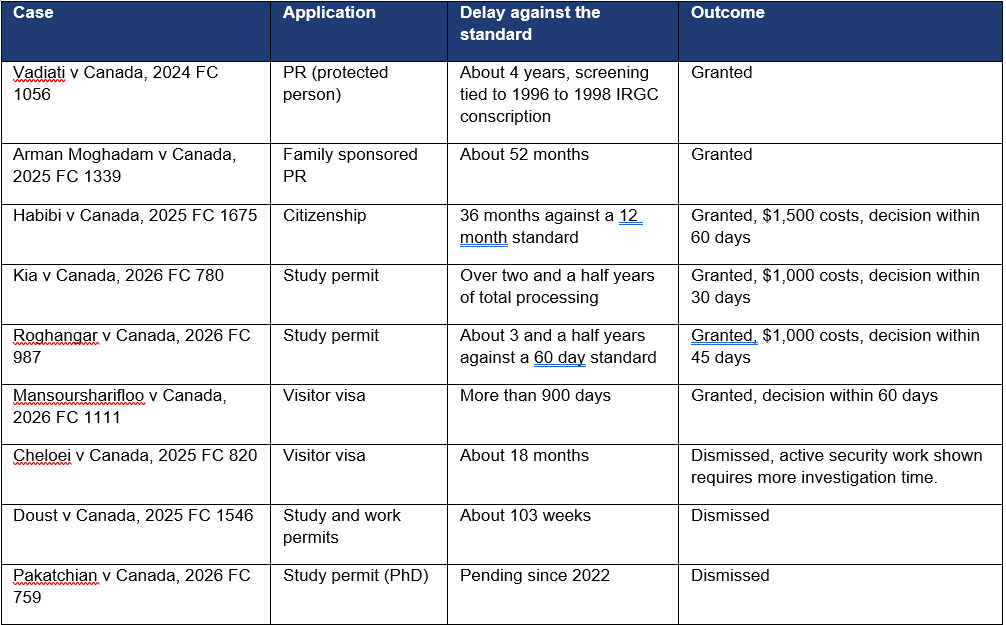
Since 2024, the Federal Court has decided a run of mandamus applications brought by Iranian applicants. Read together they set out a clear pattern, and that includes the cases you can lose.
What separates a win from a loss
- you did everything right. Complete file, fees paid, requests answered on time, and repeated follow ups.
- the GCMS notes show an unclear reason or provide no reason at all as to why there is a delay.
- there is real hardship. Separation from a spouse or children, studies put on hold, a career that cannot start.
- IRCC sent a detailed fairness letter raising a concrete inadmissibility concern, or you left one unanswered.
- the file shows active and documented processing. The Court may then decide not to step in.
The lesson from the losses is simple. A long delay on its own is not enough. What the Court weighs is whether the record explains the wait.
What separates a win from a loss
- you did everything right. Complete file, fees paid, requests answered on time, and repeated follow ups.
- the GCMS notes show an unclear reason or provide no reason at all as to why there is a delay.
- there is real hardship. Separation from a spouse or children, studies put on hold, a career that cannot start.
- IRCC sent a detailed fairness letter raising a concrete inadmissibility concern, or you left one unanswered.
- the file shows active and documented processing. The Court may then decide not to step in.
The lesson from the losses is simple. A long delay on its own is not enough. What the Court weighs is whether the record explains the wait.
4. What You Can Do Before Mandamus
Mandamus is not the first step. It is the step you take when everything else has failed, and the strength of the application depends almost entirely on the record you build in the months before you file. Almost all of that evidence comes from two requests, GCMS notes and CBSA requests, and the two are often confused with each other.
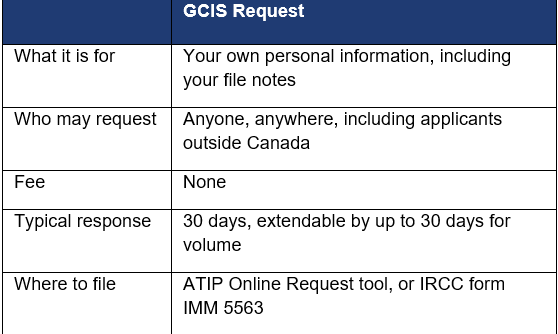
GCMS notes
The Global Case Management System (“GCMS”) is the database IRCC uses to run immigration and citizenship files. Every officer note, every stage the file passes through, every request for further information and every period of inactivity is recorded in it. When people say they have ordered their GCMS notes, they mean a copy of that record for their own file.
This is often the single most useful document in a delay case. It shows when security screening was flagged, what the officer wrote at the time, and how long the file sat untouched. Those quiet stretches where there are no updates in your file are evidence that the delay is not your fault.
CBSA Requests
A CBSA request is a separate application for records held by the Canada Border Services Agency about your own file. It matters because IRCC and CBSA are different institutions keeping different records. IRCC holds the case management history, which tells you where the file stalled and why; CBSA holds the screening side, which tells you what the security partner actually recorded and when.
CBSA notes cover much of the same ground as IRCC GCMS notes, but they include security screening information that the IRCC release does not, which is usually the whole reason to ask. Requests for your own personal information go under the Privacy Act, so there is no fee, and the right of access extends to people living outside Canada as well as inside. File through the ATIP Online Request portal, selecting CBSA as the institution, or send the written Personal Information Request form by mail. The fee for the request is $5. If a representative is filing for you, a signed consent form must accompany it, and CBSA recommends consent from anyone else who may appear in the record, such as a spouse, sponsor or adult children. CBSA has 30 calendar days to respond, and that period can be extended where the request covers a large volume of records or requires consultations. Expect portions to be withheld or severed, because security material is subject to exemptions.
The other things worth doing now
There is more to a mandamus record than the notes themselves, and most of it is inexpensive.
- Keep every enquiry you make and every automated reply you receive. A documented history of follow ups is what shows you are not responsible for the delay.
- Enquire at sensible intervals and keep a log with dates. Repeated unanswered enquiries are persuasive. A single enquiry two years ago is not.
- Check the published processing time for your exact category now, and again closer to filing. The comparison between your wait and that figure is the first branch of the legal test.
- If IRCC sends a procedural fairness letter, treat it as urgent. A detailed fairness letter raising a concrete concern can defeat a mandamus application if it goes unanswered.
- Keep the hardship documented. Medical notes, proof of separation from family, deferred admission letters from a school, or a job offer that is expiring all help.
5. Things to Look out For
When evaluating the merits of a mandamus order, the following are often the important criteria.
1.The delay is longer than this kind of process reasonably needs. In practice, comparing your wait against the processing time IRCC publishes for that category is enough to raise this.
2.You are not responsible for the delay. Prove this with GCMS notes and your own record of enquiries and follow ups. The earlier you can get GCMS notes and document those enquiries, the stronger the file. Quiet stretches in the notes, where no proper reasoning is provided and nothing happens for months, are often the most persuasive evidence you will have.
3.The government has no satisfactory explanation. This is where cases are won. IRCC routinely says a partner agency has not finished screening. Courts have held that saying so, without evidence about the nature of the investigation, is not a sufficient explanation.
6. Common Questions
How long do I have to wait before I can apply?
There is no fixed waiting period in law. The practical trigger is a wait that clearly runs past the processing time IRCC publishes, ideally paired with enquiries you have documented. Successful Iranian cases have run from about 18 months to more than 900 days. Filing too early is a real risk, and an application brought nine months into a routine processing timeline is likely to fail.
Could applying for mandamus get my application refused?
No. The order compels a decision, but it does not dictate what that decision will be. It does speed up whatever decision was coming, so an honest assessment of your file before filing matters a great deal.
Do I have to prove that I was harmed?
No. Recent decisions say plainly that proof of harm is not a precondition. That said, concrete hardship such as family separation, interrupted studies or lost career opportunities weighs in your favour.
Do I need to be in Canada?
No. Counsel files the application on your behalf, and applicants overseas have succeeded. If you are outside Canada, your representative in Canada can request your file notes on your behalf with a consent form.
What if the first application gets withdrawn?
That happens often. IRCC frequently decides, or promises to decide, once litigation is served, and the application is then withdrawn. If the file stalls again later, a second application can be brought, and Mamut is an example of a second application succeeding.
How long does the whole process take?
There is no fixed timeline, and many files resolve at the written stage. Where the Court issues an order, it typically requires a decision within 30 to 90 days. Set against that the time to obtain records first, which is usually about a month.
7. Is Mandamus Right for You?
A mandamus application is worth a serious look if most of the following describe your file.
- Your application has been pending well beyond the processing time IRCC publishes for that category.
- You have made enquiries through webforms, emails or case specific requests, and the answers have been generic or absent.
- Your GCMS/CBSA notes show security screening flagged, with long gaps in activity.
- You are separated from family, unable to study or work as planned, or watching opportunities expire.
- There has been no fairness letter raising a concrete concern that you have left unanswered.
If that sounds like your file, get a documented assessment before you file rather than after. The strength of a mandamus application is built largely in the months before it is served.
About Shidvash Bayat | Toronto Persian-Speaking Immigration Lawyer
Shidvash Bayat is a graduate of McGill University's Faculty of Law and a member of the Ontario Bar. He is currently completing the remaining articling requirements for admission to the Barreau du Québec, further expanding his ability to serve clients in both provinces.
At Lazarus Legal, Shidvash focuses his practice on immigration law and commercial litigation, assisting individuals, families, and businesses in navigating Canada's complex immigration system. He understands that immigration matters often involve more than legal procedures—they can shape a person's future, family life, and professional opportunities. With this in mind, he approaches each case with care, attention to detail, and a commitment to providing clear, practical legal guidance tailored to each client's circumstances.
Before joining Lazarus Legal, Shidvash served as legal counsel to a major international electronics company, where he advised on corporate and commercial matters, negotiated agreements, managed disputes, and addressed regulatory compliance and legal risk. This experience gives him a valuable understanding of the legal and operational needs of businesses, particularly those seeking to recruit, relocate, or retain international talent in Canada.
Shidvash also brings a strong foundation in individual client advocacy through his work with legal clinics, where he assisted people facing complex legal challenges and helped them access essential legal and community resources. These experiences reinforced his commitment to accessible, client-centred legal services and continue to inform his approach to immigration matters.
Having grown up in the Greater Toronto Area, Shidvash maintains a strong connection to the diverse communities he serves. Fluent in English, French, and Persian (Farsi), he is particularly well-positioned to assist members of the Persian-speaking community and other newcomers in navigating the Canadian legal system with confidence. His practice also encompasses civil litigation and representation before courts and administrative tribunals, allowing him to provide clients with broader legal support when needed.
Book a Consultation
If your file has stalled in security screening, the first step is a candid assessment. How long the delay has run, what the record shows, and whether a Federal Court application is likely to move it.
Lazarus Legal has offices in Toronto, Montreal, and the United Kingdom, acting for clients in Canada and overseas. Our team works in English, French, Chinese, and Persian.
To request a consultation, contact Lazarus Legal for more information.
This article is general information about Canadian immigration litigation. It is not legal advice, and reading it does not create a solicitor client relationship. Every file turns on its own facts. Accuracy of data not guaranteed.